Dr Michell Ruiz

Cirugía de hombro y del Manguito rotador
viernes, 4 de julio de 2014


jueves, 3 de julio de 2014
martes, 1 de julio de 2014
Several factors can predict rotator cuff re-tear following fixation
http://www.healio.com/orthopedics
| ||||||
 | | |||||
Several factors can predict rotator cuff re-tear following fixation
Multiple independent predictors of a re-tear following rotator cuff repair have been identified, according to recently published data. Read more | ||||||
Stay out of trouble with shoulder stabilization: Don’t miss the HAGL
Anterior capsulolabral injury (Bankart lesion) is a common cause of anterior shoulder instability that is frequently treated with excellent outcomes. However, it is important not to miss associated pathology.Read more | ||||||
Standard unilateral radiographs insufficient to determine clavicle fracture shortening
Standard, plain unilateral radiographs of the clavicle were not sufficient for fellowship-trained orthopedic surgeons to reliably determine the degree of clavicle fracture shortening or the need for surgery, according to results from a recent cohort study. Read more | ||||||


lunes, 30 de junio de 2014
Latissimus Dorsi Transfer for Rotator Cuff Tears
Latissimus Dorsi Transfer for Rotator Cuff Tears
Courtesy : Alan Hirahara, Shoulder Surgeon, Sacramento, California. www.hiraharamd.com

miércoles, 25 de junio de 2014
Ream and Run for a B2 glenoid - the x-rays and the patient's own story
http://shoulderarthritis.blogspot.mx/2014/06/ream-and-run-for-b2-glenoid-x-rays-and.html

 He desired a ream and run. At surgery we used a humeral head with a diameter of curvature of 56 mm, a height of 21, and anterior eccentricity. The glenoid was reamed to a diameter of 58 mm. The stem was fixed with impaction grafting. A rotator interval plication was used to augment his posterior stability. This approached is explained in this prior post.
His x-rays at two years are shown here.
 Note on the axillary view his anteriorly eccentric humeral head is centered in the glenoid. In spite of the fact that we did not correct his retroversion, the head is stable.

 Comment: An extraordinary result from an extraordinary effort on the part of the patient
Wednesday, June 25, 2014
Ream and Run for a B2 glenoid - the x-rays and the patient's own story
Two years ago a very physically active man in his mid thirties presented with severe pain in his right shoulder that required him to take substantial narcotic and other medication. His Simple Shoulder Test score was only 3 out of 12. His x-rays showed severe degenerative joint disease with a biconcave glenoid (type B2), posterior humeral subluxation on the glenoid, and glenoid retroversion = the bad arthritic triad (BAT).
His x-rays at two years are shown here.
His recovery was long and difficult, but he hung in there with great resolve.
Recently, he sent this email:
Greetings—I hope that you are doing well! I have owed you an email for a while, so my apologies for not being in touch sooner, but I just wanted to reach out to you and say that my shoulder if doing GREAT! It has now 100% surpassed my wildest pre-surgery hopes, and I am now back to doing virtually all of the things that I love, including sailing, which was really tough on the bionic shoulder up until two or three months ago (not that it stopped me…but it did hurt a lot). But, in early May, I did a mini-distance race, from Shileshole to Smith Island and back (85 nm), and it got kind of choppy/rough on the way home, out by near Port Townsend. A year ago I would have been in sheer agony, but when I got up the next morning and was pain-free, so I hit my rowing machine for a full workout. Amazing!
All that said, I am still careful to avoid outwards-rotation movements such as grinding winches on sailboats, but otherwise, I’m back to being a normal person, in no small part to your help and surgical magic. I still do my PT religiously, including stretching twice a day (if anything, I think that I’ve gained ROM since you saw me last!), running 3 or 4 times a week and rowing 2 or 3 times per week. It’s a lot of revolving maintenance work, but to be able to sit on a plane for 18.5 hours, pain-free (as I did yesterday, flying home from Barcelona), is truly a gift.
I’m now 2.5 years out from surgery, and based on the progression/recovery charts that I’ve seen you post on your blog, I’m guessing that I am now 100% recovered. If someone had asked me, say three years ago, if I could ever envision a largely pain-free life, I would have laughed in their face. But, this is now my reality most days (and an Aleve takes care of the rough days when I overexert my shoulder), and I just wanted to reach out and say thank you again. You made a massive difference in my life, and I will never forget the second chance that you have given me.
THANK YOU,
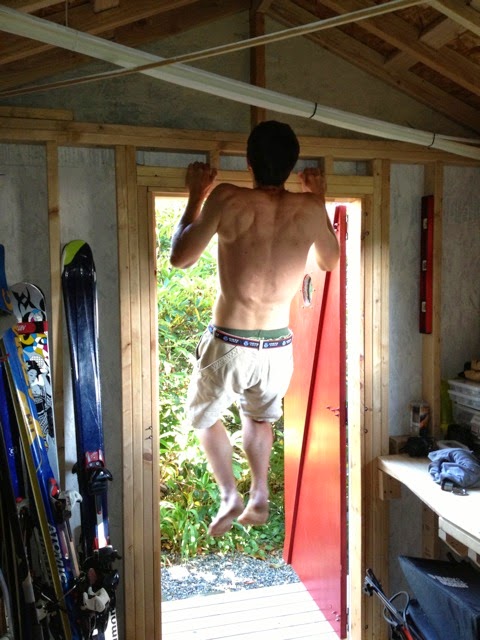
PS—this photo was taken in September of 2013…my first “honest” pull-up in roughly seven years. That was a pretty sweet victory!
jueves, 19 de junio de 2014
Nuevas prótesis inversas de hombro con la tecnología innovadora PSI
http://tecnologia.diariomedico.com/2014/02/06/area-cientifica/especialidades/tecnologia/actualidad/nuevas-protesis-inversas-hombro-tecnologia-innovadora-psi?utm_medium=twitter&utm_source=twitterfeed
Nuevas prótesis inversas de hombro con la tecnología innovadora PSI
Se han implantado nuevas prótesis inversas de hombro con una innovadora cirugía llamada Patient-Specific Instrumentation (PSI) que incluye una planificación preoperatoria asistida por ordenador.
Redacción. Madrid | 06/02/2014 17:11
El Hospital Universitario de Bellvitge ha sido pionero en el mundo en aplicar prótesis inversas de hombro con la ayuda de la innovadora tecnología PSI. Esta tecnología utiliza un potente software que reproduce tridimensionalmente el hombro del paciente, que ha sido previamente escaneada. Mediante este programa informático, el cirujano simula la colocación de la prótesis definiendo la posición e inclinación adecuadas.
"Con la planificación preoperatoria que nos ofrece este método, podemos implantar la prótesis de acuerdo con la anatomía de cada paciente en concreto y con la intención del cirujano adaptada a cada situación específica", explica Joan Armengol, responsable del estudio.
Esta intervención está indicada en procesos degenerativos graves de la articulación del hombro con desestructuración y disfunción grave de alguno de los músculos en los que la prótesis convencional sería poco efectiva. Asimismo, la personalización de la cirugía es un factor clave para minimizar las complicaciones. "No hay duda de que el futuro de la especialidad se encuentra en el desarrollo de técnicas e instrumentos cada vez más específicos para cada paciente y que la técnica PSI es un importante paso para seguir avanzando en esta dirección", destaca Armengol.
Este sistema fue desarrollado en Cleveland Clinic de Estados Unidos por J.P. Iannotti. Actualmente, se está aplicando de forma pionera en los hospitales AZ Monica de Deurne (Bélgica), Ambrosie Paré de París (Francia), Kantonsspital de Baden (Suiza) y en el Hospital Universitario de Bellvitge (Barcelona). "Es un tipo de prótesis que, en los últimos años se encuentra en auge gracias a sus buenos resultados. En el Hospital Universitario de Bellvitge, anualmente se implantan unas 20 prótesis inversas de hombro. Hasta el momento, se han implantado cuatro con la ayuda de la tecnología PSI", concluye el investigador.
Suscribirse a:
Entradas (Atom)